Connecté en tant que :
filler@godaddy.com
Connecté en tant que :
filler@godaddy.com

This guide accompanies every portrait commissioned from Lysa Karell, painter and portrait artist, and every work created at La Bottega Del Vento. From choosing the reference photograph to preserving the artwork, it brings together framing advice, the specific care of pastel and oil painting, and the habits that allow a portrait to endure for generations.
In an age when everything seems available in an instant, it is worth remembering that certain creations cannot, and should not, be rushed. A work of art conceived in the spirit of another era cannot come into being at the speed of today’s world. It is built slowly, with patience, attention and depth.
Each work is shaped entirely by hand, from the first pencil stroke to the last nuance of light. Each commissioned portrait is conceived as a unique piece, meant to preserve something precious, an emotion, a story, a bond. This takes time. It is not simply a matter of fulfilling an order, but of bringing to life a work that can accompany its owner for a lifetime.
Because quality will never be sacrificed for speed, the completion date takes into account the nature and complexity of each project, as well as certain times of the year. Each creation progresses at the pace it requires, with the care and rigour it deserves.
Creating a personalised work cannot be compared to instant production. When choosing a work made with the methods and spirit of a bygone craft, one also chooses to respect its time. Material, gesture, nuance and finish cannot be hurried without losing part of what makes the work precious.
In a world where everything can be ordered in seconds, choosing a handmade creation also means choosing to take the time to receive something unlike what is made in an instant.
The patience and trust of collectors are the precious allies of every creation meant to last.

A faithful portrait begins with the right image. For a person as for an animal, the photograph guides the proportions, the expression and the light of the work. Every detail visible in the image becomes valuable information when the time comes to draw or paint.
Always send the original file, in full resolution and without filters. A screenshot or an image sent through a messaging app is automatically compressed: fine hairs, the texture of the skin and the nuances of the iris vanish into a blur that goes unnoticed on a phone, but becomes obvious at the scale of an artwork. Filters, for their part, alter the true colours and flatten the relief of the face.
For a person, avoid photos taken at arm’s length. A phone lens held so close enlarges the nose and shrinks the ears, distorting the proportions of the face. Step back a few paces and bring the image closer with the zoom: the features regain their natural balance. Sunglasses and the shadow of a hat hide the gaze, yet it is the gaze that carries the likeness.
The profile, less common, lends the portrait an almost sculptural nobility. It reveals the line of the forehead, nose and chin with a purity no other pose offers.
For an animal, a treat or a familiar sound held just above the camera draws its gaze in the right direction at the moment the photo is taken.
Old photographs also have their place. What matters above all is the structure of the face: the shape of the eyes, the curve of the mouth, the architecture of the features. A family portrait faded by time can thus become a lasting work, provided the face remains legible. Eye or hair colour can be specified with the request when the image no longer shows it.
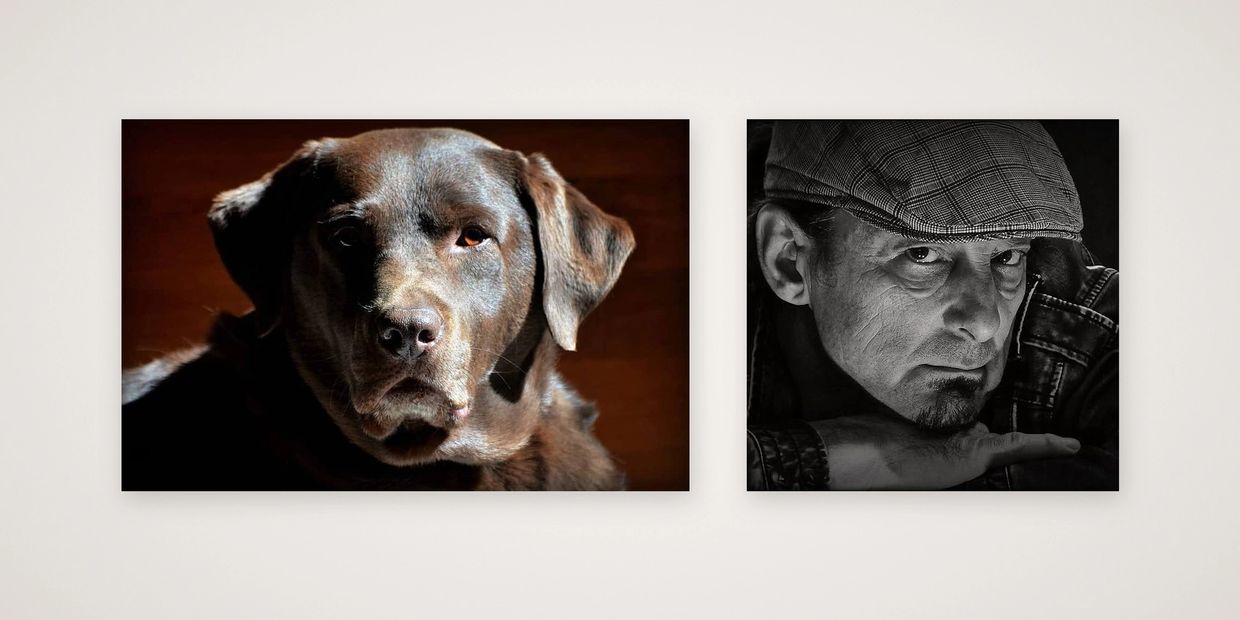
Soft light remains the safest reference, but it is not the only path. Chiaroscuro, brought to its height by Caravaggio and Rembrandt, sets light boldly against shadow. This contrast sculpts the volumes, isolates what matters and gives the subject an almost theatrical presence.
In such a portrait, shadow becomes part of the work. On the Labrador, one eye fades into the darkness while the other catches the light, and the gaze only grows more intense. In the photographer’s self-portrait, every line is carved by the raking light, and character is read in the relief. What might seem a flaw becomes a deliberate choice, rich in mystery and depth.
This approach is especially suited to black chalk, graphite and oil painting, which can render velvety blacks and very subtle transitions toward the light. A chiaroscuro work stands out in a room. It draws the eye and holds it.
Such a photograph takes a little patience, but it remains within everyone’s reach. In a dark room, place the subject near a single light source coming from the side, such as a window with the curtains half open or a lamp, and turn off all other lights. A dark background, such as a blanket or a deep-toned wall, heightens the effect. Take several images while moving the subject slightly: the light changes with every step. For an even more refined result, a photographer can also conduct the session. The portrait then faithfully follows the light of the chosen image.
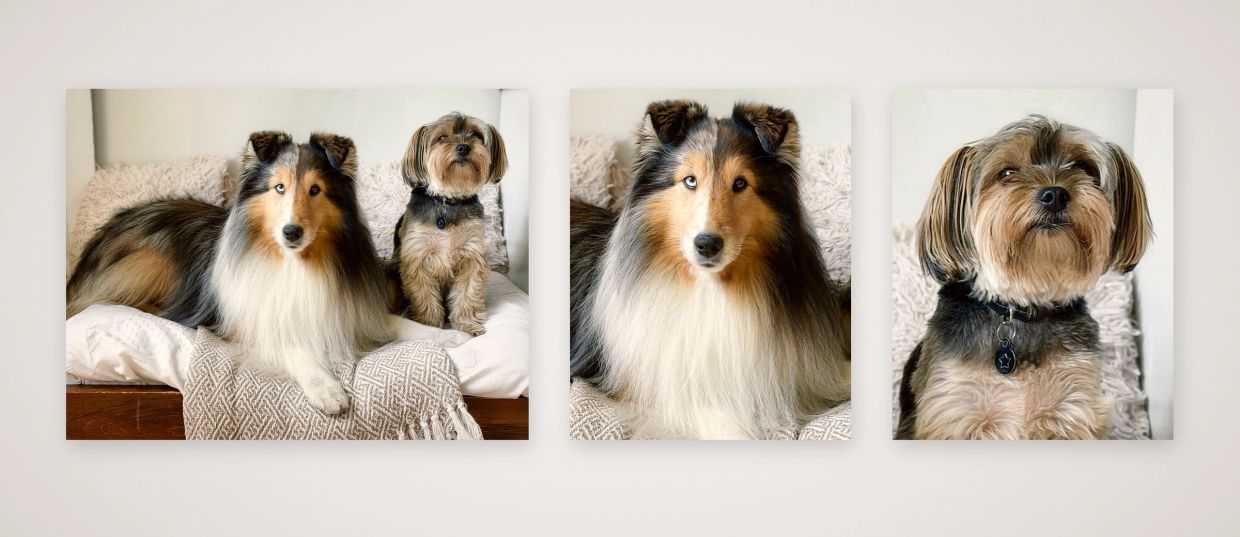
A single well-chosen photograph often offers several possible works. In this image, Daividh and Luna can be brought together in one portrait, or each become the subject of a separate work through cropping. One reference can thus yield a family portrait and two individual pieces.
Framing profoundly changes the character of a work. Tight on the head, it creates intimacy and places all attention on the gaze. Opened onto the bust, it adds the posture and bearing of the subject. Shown in full, it tells of attitude, silhouette and the subject’s place in space, and then calls for a more generous format.
To keep all these possibilities open, leave some space around the subject when taking the photograph: ears, a tail or shoulders cut off by the edge of the image cannot be recreated. The photograph must also be sharp and detailed enough to withstand enlargement, since cropping means working from a smaller portion of the image.
The framing is decided together at the time of the quote request, according to the format of the work and the place where it will hang: vertical, square or round.
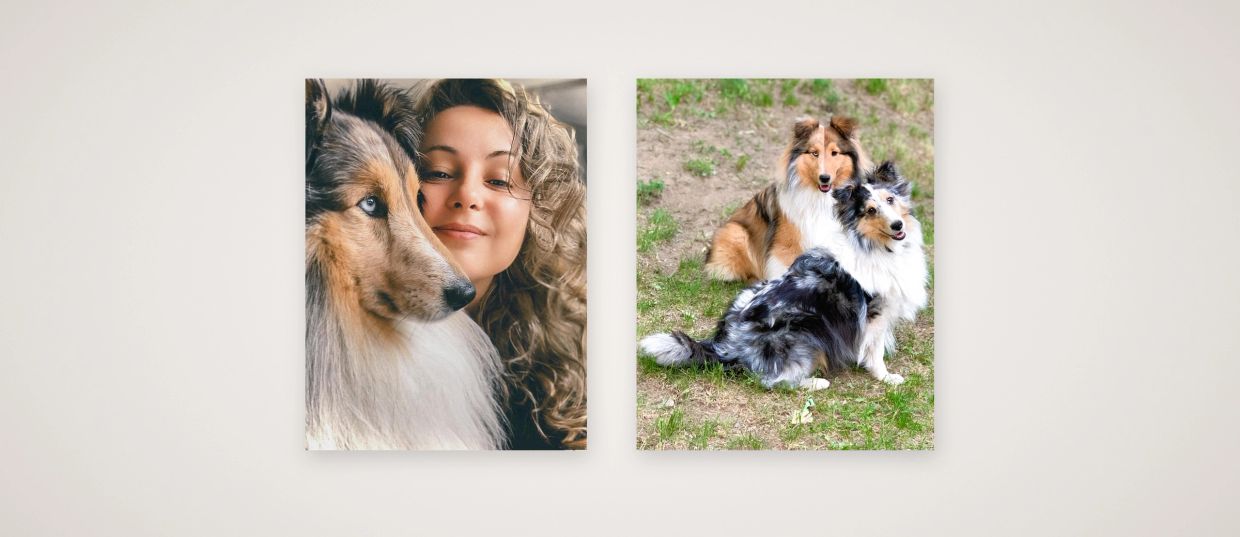
A person and their companion, two dogs of the same family, a parent and child: bringing two subjects together in one work means preserving a bond. This choice calls for particular care from the moment the photograph is selected.
When the subjects touch in the image, they form a whole. A muzzle resting against a cheek, a mother seated in front of her young: the part hidden by the other simply does not exist in the photograph. Inventing it would betray the likeness. The work therefore reproduces the scene as it was captured, and that is often where its strength lies: in the tenderness of a real moment of closeness.
When the subjects were photographed separately, bringing them together depends on the consistency of the images. The light must come from the same side, the angle of view must be similar and the distance comparable. Otherwise the shadows contradict each other, the proportions no longer match, and the eye immediately senses that the subjects never shared the same moment. Photographs taken on the same day, in the same place, give the most harmonious results.
Two subjects also need more room to breathe. A larger format gives each one its full presence, without one overpowering the other.
The arrival of an original work is a privileged moment. Depending on the collector’s preference, it travels rolled in a rigid shipping tube or flat in a reinforced box, always carefully protected and accompanied by its certificate of authenticity.
When winter makes the journey cold, it is best to let the parcel rest for a few hours at room temperature before opening it. This time to acclimatise prevents condensation, which could mark the paper or canvas.
The parcel is best opened on a clean, clear surface, with no blade or scissors near the work. A rolled work is unrolled slowly, then rests flat, face up, until it naturally regains its shape. Nothing should ever be placed on its surface. If needed, a professional framer can flatten it safely. A pastel is handled by its edges only: its surface, left free of any fixative, keeps the memory of the slightest touch.
Until it is framed, the work finds its place lying flat, in its original protection, away from any source of heat or a sunlit window.
The certificate of authenticity deserves to be kept with the household’s precious documents. It attests to the origin of the work and will follow it through every transmission.

Custom framing extends the beauty of a work. Well chosen, it offers a presentation worthy of its quality and protection suited to its medium. Entrusted to a professional framer, it becomes a natural extension of the work rather than a simple border.
The mat surrounds the work with a margin that gives it breathing room and guides the eye toward the subject. For a pastel, it also keeps the glass away from the surface. A double mat or a spacer ensures this gap, and a slight opening at the base allows fine pigment particles to fall behind the mat rather than settle on it.
Everything that touches the work should be acid-free and of museum quality. Ordinary boards yellow over the years and eventually stain the paper, irreversibly.
Anti-reflective glass lets the work be admired without glare, and museum-quality glass filters out most ultraviolet rays, which cause pigments to fade. For pastel and charcoal, glass is preferable to acrylic, whose static charge can draw unfixed pigments toward the glazing.
An oil painting is presented without glass. A floating frame, which leaves a fine gap between the canvas and the moulding, enhances its texture and gives it a gallery presence.
A work is best contemplated at eye level: its centre ideally sits about 150 cm (60 in) from the floor. Above a piece of furniture, a space of 20 to 25 cm (8 to 10 in) between the furniture and the frame creates a harmonious whole. Two hooks rather than one keep the work perfectly level, and hardware suited to the weight of the frame ensures its safety.
Every drawing in pastel, graphite or black chalk is delivered without fixative. It is a deliberate choice, deeply respectful of these noble media. A fixative is a resin dissolved in a solvent and sprayed onto the work in fine droplets. As it dries, it leaves a thin film that alters the way the material reflects light. Glass and a mat provide the protection, without taking anything away from the beauty of the drawing.
PASTEL
Pastel is almost pure pigment, held by the smallest amount of binder. Each particle of colour remains free on the surface of the paper and reflects light like no other material, hence its velvety softness and radiance. Under a fixative, light tones darken, whites lose their freshness and the superimposed layers blend together. The highlights of a gaze or the softness of a coat can fade in a single pass.
GRAPHITE
Graphite is a form of carbon mixed with clay. It offers a range of greys of great delicacy and a slight silvery sheen that brings the drawing to life. A fixative dulls this sheen and weighs down the most delicate greys, whereas glass is enough to protect the drawing from rubbing.
BLACK CHALK
Black chalk, made from carbon black pigment, yields deep, matte blacks with an almost velvety texture. It is the medium of great master drawings, from Michelangelo to Ingres. A fixative gives these blacks a sheen and erases the subtlety of their texture.
REMARKABLE DURABILITY
None of these three media yellows or cracks. The pigments of pastel and the carbon of graphite and black chalk are among the most stable materials in the history of art. The pastel portraits of Maurice Quentin de La Tour, kept under glass since the eighteenth century, retain a striking freshness, and Michelangelo’s black chalk drawings have endured for five centuries. What can yellow is the paper, when it contains acid. Each work is therefore created on acid-free art paper, chosen to last.
An oil painting does not dry by evaporation, as water does. The oil hardens slowly on contact with air, through a process of oxidation that continues long after the surface feels dry to the touch. Depending on the thickness of the paint, this hardening takes from several weeks to several months.
THE ROLE OF VARNISH
Varnish protects the painting from dust, air pollution and part of the ultraviolet rays. It also unifies the surface: some areas dry more matte than others, and varnish restores their original depth and radiance. Of professional quality, it remains removable, allowing a conservator to clean or renew it decades from now without touching the paint.
TWO OPTIONS
Varnish applied too early traps paint that is still hardening and can dull it or cause it to crack. Two options are therefore offered to the collector. If they are willing to wait until the canvas is ready, the varnish is applied by the artist before shipping. If they prefer to receive the work sooner, it is delivered unvarnished, with precise guidance on having it applied at the right time.
APPLYING THE VARNISH LATER
The canvas is ready when light pressure from a fingernail, made in a discreet corner where the paint is thickest, no longer leaves any mark. The varnish is then applied flat, on a dust-free surface, in a thin, even coat, using a wide, soft brush. The canvas then dries flat, protected from dust. A framer or conservator can also take care of it.
CARE
An oil painting is cared for simply, with light dusting using a dry brush with very soft bristles. No water, damp cloth or household product should ever touch its surface.
Acquiring a work of art is often love at first sight. When we fall in love with a creation, we naturally wish it to keep its beauty over the years. Each work, however, has its own sense of time: to age with elegance, it deserves to be protected with the same care that went into its creation. A few simple principles are enough to preserve a drawing or a painting for generations to come.
CLIMATE
Paper and canvas are living materials that react to humidity and heat. Sudden variations cause paper to buckle and canvas to slacken, and encourage mould. A stable environment, around 18 to 22 °C (64 to 72 °F) with moderate humidity, is ideal. A bathroom, a kitchen, the space above a fireplace or the vicinity of a radiator should be avoided, as should a poorly insulated exterior wall.
LIGHT
Ultraviolet rays cause the gradual fading of pigments and the ageing of paper. Their effect is slow and invisible from day to day, but irreversible. A work should therefore be kept out of direct sunlight, even when filtered through a window. Soft lighting, such as an LED lamp that emits almost no ultraviolet, shows it to advantage without harming it.
ENVIRONMENT
Dust, smoke, cooking vapours, solvents and household products deposit particles that eventually penetrate the fibres of the paper or the surface of the canvas. Some insects are also drawn to paper. A frame well sealed at the back, a clean and ventilated room, and gentle care are enough to keep these threats at bay.
A portrait drawn or painted by hand becomes, over the years, an object of memory. Chosen with care, framed with precision and preserved with attention, it takes on a value that time only deepens.
A portrait in pastel, black chalk, graphite or oil, of a loved one or a faithful companion: every quote request marks the beginning of a singular creation.
“Drawing is a battle between nature and the artist. The goal is not to copy, but to interpret.”
Charles Baudelaire
Profile portrait, Labrador portrait and chiaroscuro self-portrait by Bobby Ray, photographer.
Ce site utilise des cookies afin d’analyser le trafic et d’améliorer votre expérience de navigation. En poursuivant votre visite, vous consentez à leur utilisation.
This website uses cookies to analyze traffic and improve your browsing experience. By continuing to visit, you consent to their use.
